Marta town belonged to Farnese Family
Marta town belonged to Farnese Family as part of the Dukedom of Castro.
The documented history of Marta begins in 726 A.C. when its name appears in a donation act for the establishment of Saint Peter’s estate in Tuscia.
Marta town belonged to Farnese Family
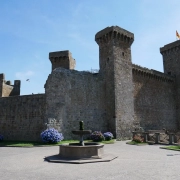
Pope Urban IV ordered the building of the Fortress in the 13th century. The octagonal Clock Tower of the Fortress survived the passing of time and it is the symbol of the town.
Marta belonged to Farnese family as part of the Dukedom of Castro where it entered in 1537. After the Church destroyed the Dukedom of Castro, the town returned under the ruling of the Church.

Virgin of the Mountain Sanctuary
Virgin of the Mountain Sanctuary is situated on a panoramic hill at a small distance from the center of Marta. The Sanctuary is in Romanesque style with a Renaissance portal. Inside there is a painting of Virgin Mary dating back to the Florentine school.

The religious festival named “Barabbata” takes place in Marta each year on May 14th for the celebration of the Virgin of the Mountain. Barabbata festival has very old pagan origins (was honoring the goddess Ceres).
The Silverside Fish Festival (a small and tasty fish from the lake) takes place one week after the Barabbata.
Martana Island
Martana Island is situated on Bolsena lake at 2 km away from Marta. The island is what remained after the eruption of an underwater cone of the volcano that formed Bolsena lake. The island is uninhabited and has a trace of Etruscan presence represented by a memorial stone.

Santa Cristina of Bolsena was prisoner on Martana island. The Romans forced Santa Cristina to renounce to the Christian faith. The Romans martyrized her because she refused to renounce to her faith. She was only 11 years old..
Theodahad imprisoned Queen Amalasuntha, the daughter of Teodorico, King of the Goths, in the tower on Martana island in 534 A.C. Theodahad killed Queen Amalasuntha in 535 A.C. for succession reasons.
During the invasions of the Goths the island became a safe refuge for the populations fleeing the settlements around the lake.
The island shelters the ruins of a Medieval castle and the ruins of the Church of San Stefano and San Valentino from the 9th century.
The inhabitants of Viterbo conquered the island in 1095. In the 14th century, under papal control, the island was most splendid.